
A selection of work where N-Control supplied the control, motion or engineering — as a subcontractor or directly for the end user, on installations that have to run in production.
- A cobot cell that keeps a lathe cutting
Robot tending for a CNC lathe — EH Stål - Programming a pharma QC cell — and the programmer to keep it running
Machine software and mentoring — PPS - Holding register at a thousand labels a minute
Vision triggering, tension control and product tracking — PPS PharmaJet - Commissioning the facilities for a new fibre-optic plant
Project management, QA and control-loop design — OFS Fitel
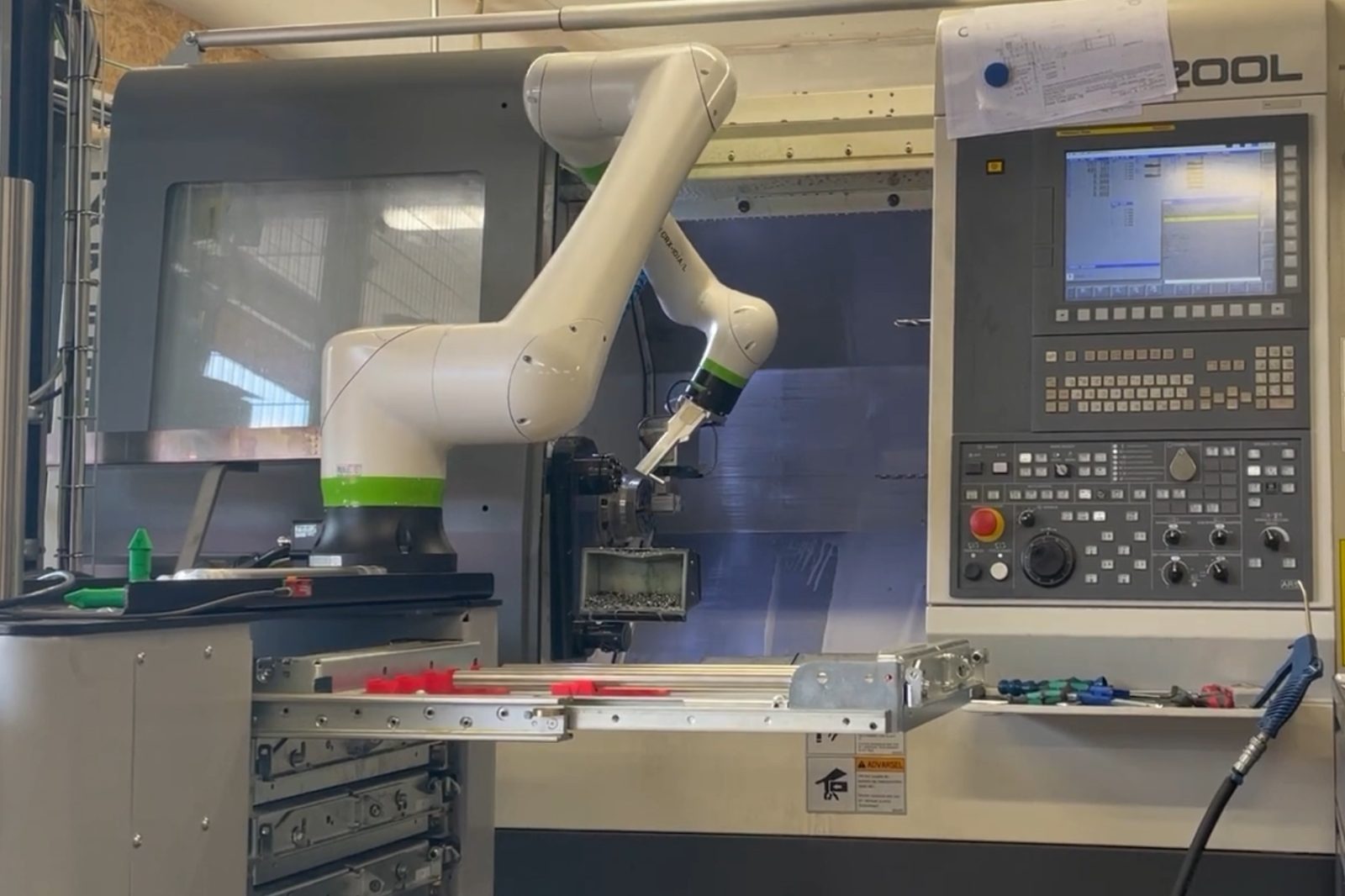
A cobot cell that keeps a lathe cutting
EH Stål (end user) · subcontract to PL Data Teknik ApS · Fanuc CRX-10iA/L cobot, Beckhoff PLC and HMI
The challenge
A lathe only earns money while it is cutting, and a lathe that has to be loaded by hand stops every time nobody is standing at it. Automating the loading is the easy half. The hard half is order changes: in a job shop the next order looks nothing like the last one, and an automation cell that has to be reprogrammed for every batch costs more time than it saves.
What I did
A robot tending cell built around a Fanuc CRX-10iA/L collaborative robot as the primary manipulator, with a Beckhoff PLC as top-level control for the cell and the operator interface. Putting the PLC above the robot rather than beside it is the decision the whole cell rests on: the robot handles the movement, while the sequencing, interlocking with the lathe and the state of the cell sit in one controller that the rest of the workshop equipment can also talk to.
Changeover is handled through recipes. A new order is set up by selecting it on the HMI rather than by editing robot programs, so the people running the cell are machinists, not programmers.
The result
The lathe runs uninterrupted through breaks and unattended periods, and resetting the cell for a new order is a matter of minutes on the panel — which is what makes the cell worth having in a shop that changes orders often.
Programming a pharma QC cell — and the programmer to keep it running
Subcontract to PPS A/S (PPS Automation) · pharmaceutical QC laboratory · Beckhoff PLC and web HMI, collaborative robot
The challenge
A pharmaceutical manufacturer needed its quality-control laboratory automated: assembling vials and caps, labelling them and serialising the result, in a cell small enough for a lab and modular enough to be folded into a production line later. Standard equipment did not cover it, so PPS built it as a proof of concept. Two things had to happen on the same schedule — the machine had to be programmed, and a newly hired programmer had to be brought up to speed on the platform.
What I did
I programmed part of the machine and worked alongside the new programmer while doing it — code structure and conventions, the Beckhoff platform and its web HMI, and how to lay out sequencing and motion so a modular cell still holds together when it is later integrated into a line. Training on a live project rather than in a classroom: the code being reviewed was the code being shipped.
The result
The cell was delivered as a working proof of concept, controlled and monitored from a Beckhoff web HMI that also allows the customer to follow it remotely. Just as importantly, the platform knowledge stayed with PPS rather than leaving with the consultant. PPS describes the solution here.
Holding register at a thousand labels a minute
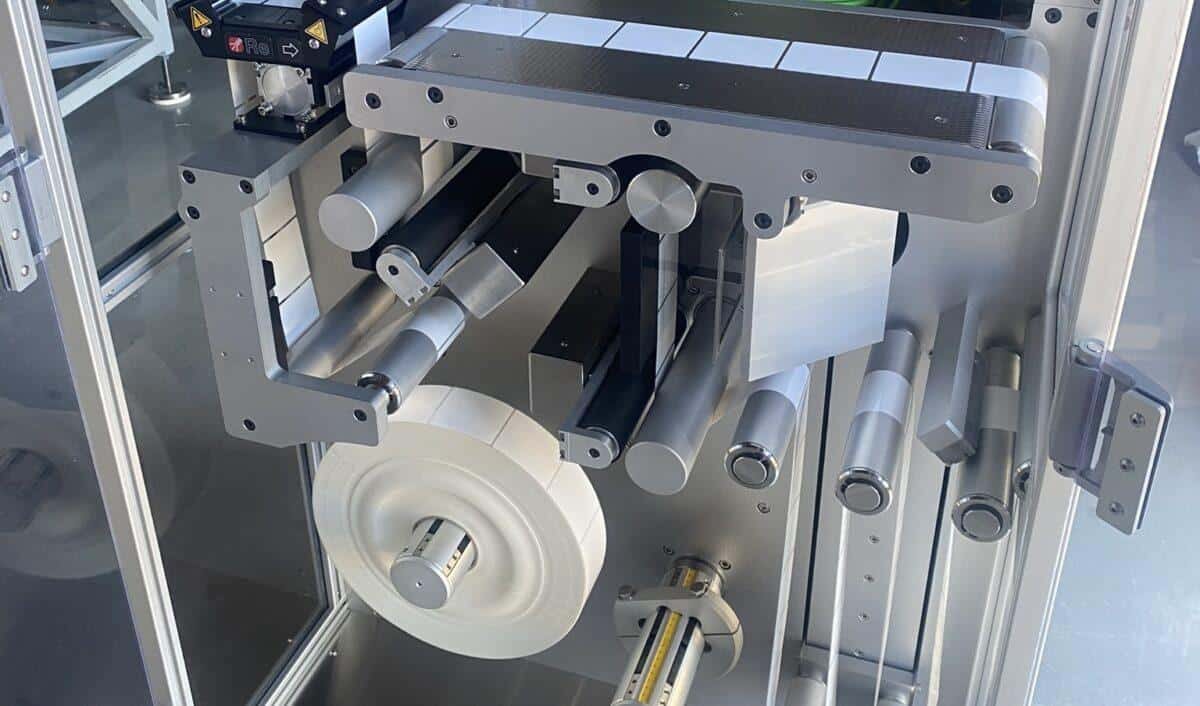
Subcontract to PPS A/S · digital inline label printing for pharma · vision triggering, web tension control, product tracking
The challenge
The PharmaJet prints full-colour serialised labels inline, inspects every one of them and applies them to the product — at up to a thousand labels a minute, in a footprint of less than a square metre. At that rate the machine is one long timing problem. The camera has to fire at the same point on every label while the web is moving. Liner tension has to stay constant, or the print walks out of register. And each individual label has to be followed from the print head through inspection to the depositor, so the right label reaches the right product and a rejected one is pulled rather than applied.
What I did
I implemented three parts of the machine control: the synchronous triggering of the vision inspection, the control algorithms for web and liner tension, and the tracking shift register that carries each label’s identity through the machine and into the label depositor.
None of that is done with a software timer. Label position is picked up on high-precision touch-probe inputs — the standard approach in labelling, because the edge has to be captured at the instant it passes the sensor, not at the instant the controller next gets round to looking. The camera is then fired from Beckhoff EtherCAT outputs with the same precision, referenced to the bus clock rather than to the program cycle.
The vision system itself was somebody else's work. The timing that makes it usable at speed was mine: an inspection camera is only as good as the moment it is triggered, and on a moving web that moment has to come from the machine, not from a clock running alongside it.
The result
The machine runs at up to 1,000 fully serialised full-colour labels per minute with 100% inspection of both text and colour matching, which removes the need to hold pre-printed label stock at all. PPS describes the PharmaJet here.
Commissioning the facilities for a new fibre-optic plant
OFS Fitel A/S (now Lightera) · BMS and CTS, HVAC, process cooling · since 2018
The challenge
A new fibre-optic production site needed its building management and CTS installations supervised and commissioned. The scope had stalled — it needed someone who had commissioned facilities of this kind before and could pick it up mid-flight.
What I did
On-site supervision and commissioning of the BMS and CTS installations, which grew to cover ventilation, process cooling and the HVAC systems. The core services are project management, quality assurance and control-loop design — advisory work on the client’s side of the table rather than delivery of a machine.
The result
A scope that was in limbo was taken over and completed, and the engagement has since been extended into neighbouring systems on the same site.
Working on something similar?
Describe the machine and what it has to do. Get in touch and you will hear how I would approach it.